
In this article
- The two kinds of ecommerce personalization
- Does personalization work? What the research says
- Types of experience personalization
- Best ecommerce personalization platforms compared
- Product personalization: letting customers customize the product
- Product personalization tools compared
- Ecommerce personalization examples
- Privacy and consent
- How to start: a plan for small and mid-size stores
- Frequently asked questions
- Keep exploring
Ecommerce personalization means tailoring an online store to each shopper. It comes in two kinds. Experience personalization changes what a shopper sees (product recommendations, search results, emails and on-site content) based on their behavior. Product personalization lets the shopper change the product itself, adding a name, photo, monogram or design before they buy. Most small and mid-size stores start with a free recommendations tool and a product personalizer, then add a full personalization platform once traffic and revenue justify the cost, which for enterprise platforms often runs to tens of thousands of dollars a year.
This guide explains both kinds, what the research says about results, the main platforms and tools with their real prices (checked in October 2026), how to choose one for your store's size, and the privacy rules to follow.
Key takeaways
- Ecommerce personalization has two kinds: experience personalization (recommendations, search, email) and product personalization (customers customize the product).
- McKinsey found 71% of consumers expect personalization and it most often lifts revenue 10% to 15%; results depend on execution.
- Recommendations cost from $0 (Shopify Search & Discovery) to about $10 to $25 a month for Shopify apps, up to $60,000+ a year for enterprise platforms like Bloomreach.
- Product personalization tools range from PIMW Product Personalizer (free plan, $7.99 to $24.99 a month, no per-order fees) to Zakeke 3D and AR ($69.90 a month plus 1.9% per custom sale).
The two kinds of ecommerce personalization

| Experience personalization | Product personalization | |
|---|---|---|
| What changes | What the shopper sees | The product the shopper buys |
| Examples | "You may also like", personalized search, abandoned cart emails | Engraved jewelry, photo mugs, name t-shirts, custom logos |
| Data it needs | Browsing, purchase and email data | What the customer types or uploads |
| Typical tools | Recommendation engines, email platforms, personalization platforms | Product personalizers and customizers |
| Main benefit | Shoppers find more relevant products | A unique product that can carry a higher price |
They work well together: recommendations bring shoppers to the right product, and personalization gives them a reason to buy it from you rather than a store selling the same item.
Does personalization work? What the research says
The most quoted numbers come from a handful of studies. Here is what they actually say:
- Shoppers expect it. McKinsey's 2021 research found that 71% of consumers expect companies to deliver personalized interactions, and 76% get frustrated when this doesn't happen.
- It lifts revenue, but not by magic. McKinsey says personalization most often drives a 10% to 15% revenue lift, with company-specific results from 5% to 25% depending on the sector and how well it's executed. It also found that companies that excel at personalization generate 40% more revenue from those activities than average players. That's 40% more from personalization, not 40% more revenue overall, as it's sometimes misquoted.
- It influences purchase intent. In Epsilon's 2017 survey of 1,000 US consumers, 80% said they were more likely to do business with a company that offers personalized experiences, and 90% found personalization appealing.
- Businesses are investing. In Twilio Segment's 2024 State of Personalization report, 89% of business leaders said personalization is crucial to their success over the next three years, and 61% worried that inaccurate data could undermine AI-driven personalization.
- There's demand for personalized products. In Deloitte's 2015 UK survey of 1,560 adults, 36% of consumers were interested in buying personalized products or services, and 1 in 5 of those interested were willing to pay a 20% premium.
Treat survey figures as direction, not a promise. Expectations are high, results depend on execution, and bad data or irrelevant recommendations can do more harm than none.
Types of experience personalization
- Product recommendations: "Frequently bought together", "You may also like", recently viewed and complementary products on product, cart and checkout pages.
- Personalized search and merchandising: search results and collection sorting that reflect what the shopper (or shoppers like them) tend to buy.
- Email and SMS: abandoned cart, browse abandonment, post-purchase and win-back messages based on behavior.
- On-site content: banners, offers and homepage sections that change by location, traffic source, new vs returning visitor or past purchases.
- Bundles and upsells: personalized bundle offers in the cart and after purchase.
- Customized pricing: usually volume, tiered or B2B pricing for specific customer groups. Showing different shoppers different prices for the same product, based on their data, is a different matter and can quickly damage trust, so be careful with it.
Start with recommendations and email. They need the least data and the least effort to see results.
Best ecommerce personalization platforms compared

Here is how the main experience personalization platforms looked in October 2026:
| Platform | Best for | Starting price | Free option | Shopify app rating |
|---|---|---|---|---|
| Shopify Search & Discovery | Shopify stores starting out | Free | Yes | 2.6 (510 reviews) |
| LimeSpot | Small Shopify stores (recommendations, bundles) | $9.99/month, scales with orders | Yes, up to 10 orders a month | 4.6 (506 reviews) |
| Rebuy Personalization Engine | Growing Shopify stores (recommendations, cart, post-purchase) | $25/month, scales with orders | Yes (Rebuy Monetize) | 4.7 (854 reviews) |
| Klaviyo | Email and SMS personalization | Free up to 250 active profiles, then by profiles | Yes | n/a |
| Algolia Recommend | Developers using an API | Free for 5,000 requests a month; $0.60 per extra 1,000 on paid plans | Yes | n/a |
| Nosto | Mid-size and large online retailers | Custom pricing (platform fee plus a fee based on sales and traffic) | No | n/a |
| Bloomreach | Large brands (email, search, automation) | "$60K+ a year for most brands", per Bloomreach | No | n/a |
| Dynamic Yield (Mastercard) | Enterprise retailers | Not published; requires a paid account | No | 5.0 (2 reviews) |
How to choose by store size:
- Small stores (under a few hundred orders a month): Shopify Search & Discovery for basic related products, plus Klaviyo's free plan or a low-cost app like LimeSpot. Spend your effort on good product pages and emails, not on a big platform.
- Mid-size stores: Rebuy or LimeSpot for on-site recommendations and bundles, with Klaviyo for email. Look at Nosto when you need personalized search, merchandising and testing in one place.
- Enterprise: Nosto, Bloomreach or Dynamic Yield, which combine recommendations, search, testing and segmentation, with pricing negotiated on your traffic and revenue.
What it costs to add personalized recommendations: from $0 (Shopify Search & Discovery, Algolia's free tier, Rebuy Monetize), through roughly $10 to $25 a month and up for Shopify apps that scale with your orders, to custom enterprise contracts. Bloomreach, for example, says most brands pay $60,000 or more a year.
Product personalization: letting customers customize the product

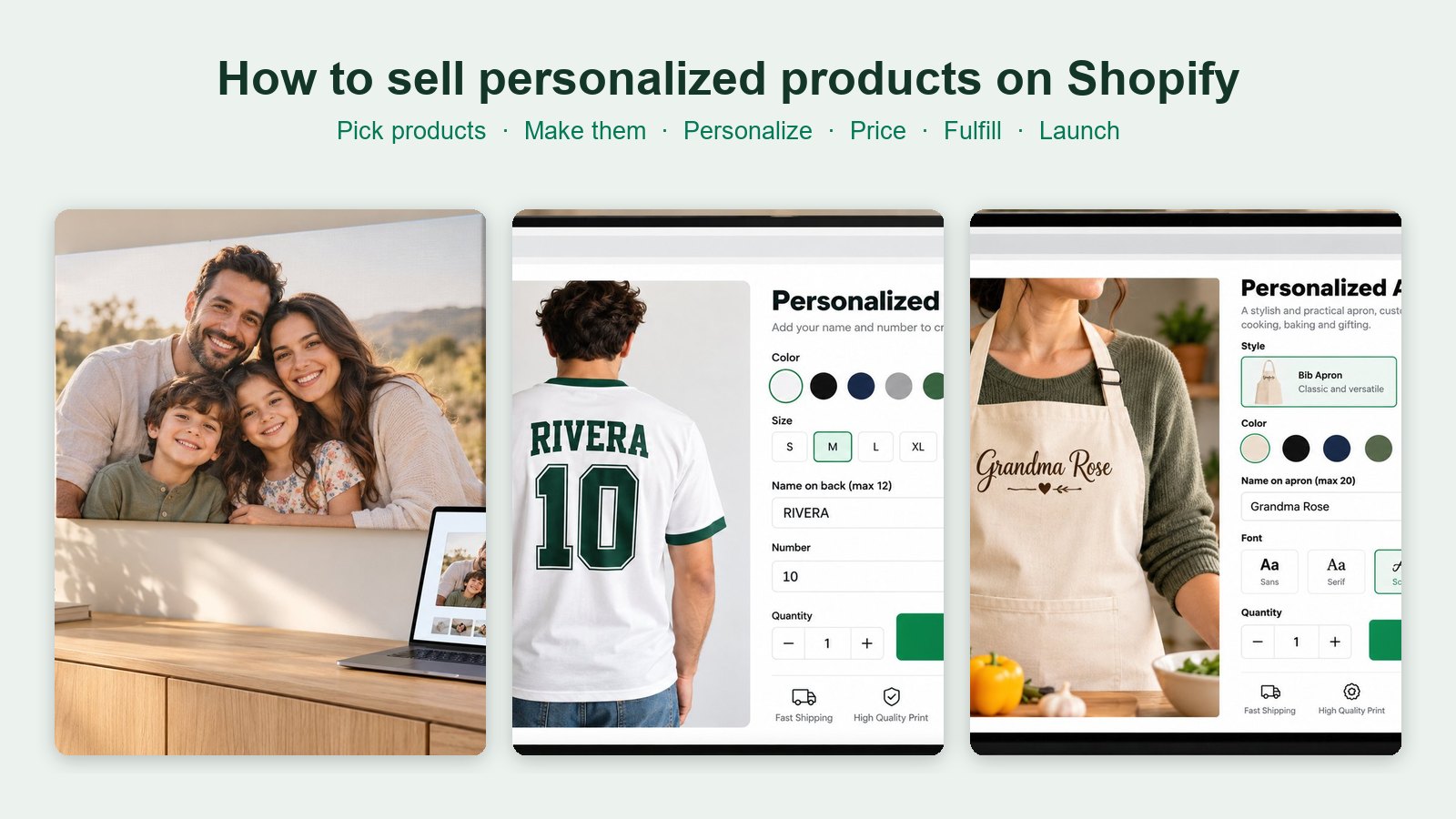
Product personalization (also called product customization) turns a standard product into a unique one: a necklace engraved with a date, a mug with a family photo, a t-shirt with a team name, a logo on a staff apron. It's especially strong for gifts, where the personal detail is the reason to buy.
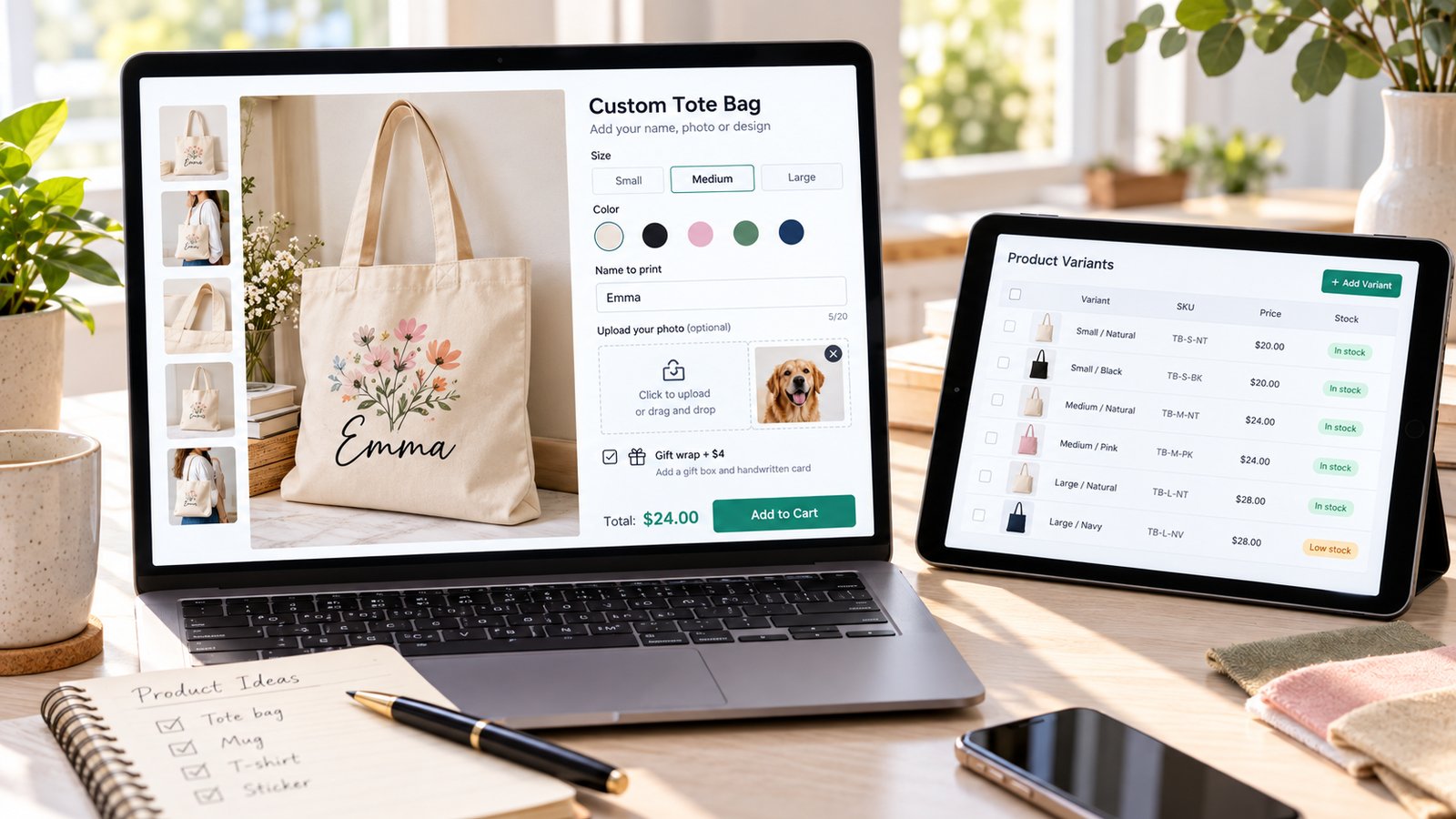
A good product personalization setup has:
- Text fields with character limits, and font choices that stay readable on the product.
- Photo or logo upload, with resolution guidance.
- Color and style swatches.
- A live preview showing the customer's text or photo on the product before they buy.
- Add-on pricing for engraving, extra lines, gift wrap or a second print side.
- Conditional logic, so advanced options appear only when needed.
- Order details saved exactly as the customer entered them, so production gets it right.
Our guide to selling personalized products on Shopify covers the whole process, from choosing products to pricing and returns.
Product personalization tools compared
| Tool | Type | Starting price (monthly) | Per-order fees | Free plan | Shopify app rating |
|---|---|---|---|---|---|
| PIMW Product Personalizer | Personalizer and product options | $7.99 | None | Yes | 5.0 (9 reviews) |
| Teeinblue | Personalizer for print on demand | $49 | $0.10 to $0.40 per order item (first 100 orders a month free of fees) | Development stores only | 4.9 (380 reviews) |
| Customily | Personalizer for print on demand | $49 | $0.10 to $1 per order item | Development stores only | 4.9 (276 reviews) |
| Kickflip | Visual product configurator | $59 | 1.95% to 0% per custom product sale | No | 4.4 (136 reviews) |
| Zakeke | 2D and 3D customizer with AR | $69.90 ($59 billed yearly) | 1.9% per custom sale on Starter | Development stores only | 4.5 (101 reviews) |
Can shoppers customize products in 3D and AR? Yes, with a tool like Zakeke. Its site describes real-time product customization with interactive 3D configuration and AR visualization, and its pricing page lists 3D live preview and augmented reality on all plans. That suits complex products like furniture, shoes or packaging, at a higher price plus a fee on each custom sale.
PIMW Product Personalizer is our app, built for Shopify stores that sell personalized products without paying per order. Its Shopify App Store listing shows:
- Features: text and engraving fields, image uploads, color swatches, conditional logic, add-on pricing rules and a live preview.
- Plans: Free (1 option group with 2 fields, on up to 10 products), Basic $7.99, Pro $13.99 and Unlimited $24.99 a month, with a 3-day trial on paid plans.
- No per-order fees: every plan includes unlimited custom orders.
- Photo upload for customers is on Pro (up to 20 images per personalizer) and Unlimited.
Our page on the tool for selling personalized gifts shows how it works for gift stores, and our guide to adding product options in Shopify compares it with other options apps.
How to choose a product personalization tool:
- Names, monograms, engraving and simple options: a personalizer with a free or low-cost plan and no per-order fees.
- Print-on-demand photo products at volume: compare per-order fees carefully. At 1,000 orders a month, a $0.10 to $1 fee per item adds $100 to $1,000 to your bill.
- 3D products and AR: a 3D configurator like Zakeke or Kickflip, if the product needs it.
Ecommerce personalization examples

- A jewelry store combines product personalization (engraved names and birthstones, with a preview) with recommendations ("Complete the set").
- A print-on-demand mug shop lets customers upload a photo and add a name, then emails a "matching mug for Dad" offer before Father's Day.
- A cafe supply store recommends aprons to customers who bought mugs, and lets businesses upload their logo for staff aprons.
- A gift shop shows different homepage banners to returning customers ("Your last order: reorder with a new name") and new visitors ("Personalized gifts from $19").
- A fashion store uses personalized search and size recommendations based on past purchases.
Privacy and consent
Personalization runs on data, so it has to follow privacy rules.
- UK and EU cookie consent. The UK's ICO says consent for cookies must be actively and clearly given, and that continuing to browse a site isn't consent. Only cookies strictly necessary for a service the user asked for, such as a shopping basket, are exempt. Tracking cookies used for behavioral personalization need clear consent.
- Third-party cookies. In April 2025, Google said it will keep its current approach of offering users a choice about third-party cookies in Chrome, instead of rolling out a new standalone prompt.
- First-party data is the safer base. What customers buy, browse and enter on your own store, plus email preferences they give you, is the most reliable data for personalization.
Product personalization needs very little tracking: the customer tells you exactly what they want, in a text box or an upload, as part of the order.
How to start: a plan for small and mid-size stores
- Fix the basics first: clear product pages, good photos, fast load times.
- Add free recommendations: related and complementary products with Shopify Search & Discovery or a free app tier.
- Set up behavior-based emails: abandoned cart, browse abandonment and post-purchase flows.
- Add product personalization to your best gift products: names, photos and a live preview, with an add-on price.
- Measure: compare conversion rate, average order value and repeat purchases before and after each change.
- Upgrade to a paid recommendations app or a full platform only when traffic and revenue justify it.
- Review privacy: a cookie consent banner, a clear privacy policy and only the data you need.
Personalization works best when it's useful, not creepy: recommendations shoppers actually want, emails that arrive at the right moment, and products they can make their own.
Frequently asked questions
What is ecommerce personalization?
Tailoring an online store to each shopper. Experience personalization changes what shoppers see, such as recommendations, search results and emails, based on their behavior. Product personalization lets shoppers customize the product itself with a name, photo or design.
What is the best ecommerce personalization platform?
It depends on size. Small Shopify stores can start with the free Shopify Search & Discovery app or LimeSpot (from $9.99 a month). Growing stores often use Rebuy (from $25 a month) with Klaviyo for email. Large retailers use Nosto, Bloomreach or Dynamic Yield, which have custom pricing.
How much does ecommerce personalization cost?
From free (Shopify Search & Discovery, Algolia's free tier) to about $10 to $25 a month and up for Shopify recommendation apps that scale with orders. Enterprise platforms are custom-priced; Bloomreach says most brands pay $60,000 or more a year.
What is ecommerce product personalization?
Letting customers customize a product before buying, such as engraving a name, uploading a photo or choosing colors, with a live preview. Tools include PIMW Product Personalizer (free plan, no per-order fees), Teeinblue and Customily ($49 a month plus per-order fees) and Zakeke for 3D and AR.
Can shoppers customize products in 3D and AR?
Yes, with a 3D configurator like Zakeke, which offers real-time customization with a live 3D preview and AR viewing on all plans. Its Shopify plans start at $69.90 a month plus 1.9% per custom sale, as checked in October 2026.
Does personalization increase sales?
Usually, when done well. McKinsey found personalization most often drives a 10% to 15% revenue lift, ranging from 5% to 25% by company. In Epsilon's survey, 80% of consumers said they were more likely to do business with a company offering personalized experiences.
Keep exploring
Sources & further reading
Primary sources referenced in this article. We link to official platform documentation and standards bodies rather than secondary summaries so you can verify claims directly.
- McKinsey: The value of getting personalization right, or wrong, is multiplying (2021)
- Epsilon: Personalization research (2018 press release)
- Twilio Segment: State of Personalization Report 2024
- Deloitte: Made-to-order, the rise of mass personalisation (2015, archived)
- Shopify App Store: Search & Discovery
- Shopify App Store: LimeSpot
- Shopify App Store: Rebuy Personalization Engine
- Klaviyo: Pricing
- Algolia: Pricing
- Nosto: Pricing
- Bloomreach: Pricing
- Shopify App Store: Dynamic Yield by Mastercard
- Zakeke: Product customizer, 3D and AR
- Zakeke: Pricing
- Shopify App Store: Customily
- Shopify App Store: Teeinblue
- Shopify App Store: Kickflip
- Shopify App Store: PIMW Product Personalizer
- ICO: Cookies and similar technologies
- Google Privacy Sandbox: Next steps (April 2025)