
In this article
- Pick your business model and niche
- Set up the business before the store
- Source findings, blanks and samples
- Build your Shopify store step by step
- Payments, fraud and chargebacks
- Shipping jewelry safely
- Write a returns policy for both kinds of pieces
- Build trust before the first sale
- Launch checklist and your first 30 days
- Common mistakes to avoid
- Frequently asked questions
- Keep exploring
To start a jewelry business online with Shopify, pick one business model and a narrow niche, register the business and sort out tax, order samples from two or three suppliers, then build a small store: a jewelry-friendly theme, collections by type and metal, variants for metal and size, and a personalization field with a live preview if you engrave.
After that, the work is mostly about protecting high-value orders: fraud checks, insured and signed-for shipping, and a returns policy that treats personalized pieces differently from stock pieces.
This guide follows the order we see new jewelry merchants work in, for one-person shops and small brands in the US, UK and India.
For production models, marketplace fees, pricing and metal claims, our guide to selling personalized jewellery online goes deeper. Here we stay with building the store.
Key takeaways
- Pick one model (handmade, made-to-order, curated or print-on-demand) and a niche you can describe as occasion, recipient and metal in one sentence.
- Use variants for metal, ring size and chain length, and line-item properties for engraving text; Shopify allows three options and up to 2,048 variants per product.
- Review every medium and high risk order before you engrave, because an engraved piece can't be resold and Shopify doesn't cover bank charge reversals.
- Insure every parcel and require a signature on valuable orders; at the time of writing USPS includes $100 of cover on Priority Mail and Ground Advantage.
Pick your business model and niche

Decide this in an afternoon, not a month. Your model sets your margins, your sourcing and how you build products in Shopify.
- Handmade. You make every piece. Highest margin, lowest volume.
- Made-to-order personalized. You stock blanks and engrave or stamp a name after the order comes in.
- Curated or wholesale. You buy finished pieces in bulk and resell them under your brand.
- Print-on-demand. A supplier makes and ships each piece when it sells. Our guide to POD jewelry and necklaces shows what that catalog looks like.
| Model | Startup cash | Inventory | Shopify setup | Good first niche |
|---|---|---|---|---|
| Handmade | Medium (tools, materials) | Raw materials | Variants for metal and size | Stacking rings, beaded bracelets |
| Made-to-order personalized | Low to medium (blanks, engraver) | Blanks only | Variants plus personalization fields | Name necklaces, engraved bars |
| Curated or wholesale | Medium to high (stock orders) | Finished pieces | Variants, strong photos | Pearl studs, gold-tone chains |
| Print-on-demand | Low (samples) | None | Supplier app plus personalization | Printed keepsake pendants |
Then narrow the niche. "Jewelry" is not a niche. "Engraved sterling silver jewelry for new moms" is. It gives you an obvious collection structure, a clear ad audience and a reason to buy from you instead of a department store.
A quick test: can you name the occasion, the recipient and the metal in one sentence? If you need three sentences, cut something.
Still choosing between pieces? Our jewelry personalizer hub shows how each type is usually set up and what customers tend to type.
Set up the business before the store
You can build the store in a weekend. The legal and money side takes longer, so start it first. This is general information, not legal or tax advice.
Register the business
In the US, the SBA lists the usual order: pick and protect a name, register with your state if you form an LLC or corporation, get a free EIN from the IRS, check whether your state needs a separate tax ID, and apply for local licenses. The SBA says most businesses pay less than $300 in total to register.
In the UK, you can trade as a sole trader straight away, but gov.uk says you must register for Self Assessment once you earn more than £1,000 in a tax year. A limited company must be registered before it trades.
In India, most online sellers start as a sole proprietorship or LLP and get GST registration early, because marketplaces and payment gateways ask for it. A chartered accountant can confirm what applies to you.
| Task | US | UK | India |
|---|---|---|---|
| Structure | Sole proprietor, LLC or corporation | Sole trader or limited company | Proprietorship, LLP or private limited |
| Tax registration | EIN, plus state tax ID where needed | Self Assessment or company registration | PAN, plus GST registration |
| Tax at checkout | State sales tax where you must collect | VAT once you pass the HMRC threshold | GST on each sale |
| Who to ask | State revenue department, an accountant | HMRC guidance, an accountant | A chartered accountant |
Shopify can calculate tax at checkout, but registering and filing is still your job. Set it up before your first sale.
Open a business bank account
Keep business money separate from day one. Bookkeeping gets simpler and tax time hurts less. In the US you'll usually need your EIN to open one.
Insure stock and shipments
Jewelry is small, valuable and easy to steal, so think about two kinds of cover. The first protects stock and tools at home or in a studio. The SBA notes that a home-based business rider on a homeowner's policy covers only a small amount of business equipment, so check that limit against the value of your gold and silver.
The second covers parcels in transit, which carrier insurance handles per shipment (see the shipping section). If you sell pieces worn on the skin, ask your insurer about product liability cover too.
Source findings, blanks and samples

Findings are the small parts: clasps, jump rings, ear wires, bails and chain. Blanks are the plates, discs, bars and rings you personalize. Unless you cast everything yourself, you'll buy both.
Look at jewelry supply wholesalers, casting houses, trade fairs and workshops that take trade orders. In India, karigar workshops often take small trade orders. We don't name suppliers here because quality changes batch to batch.
Most wholesalers set a minimum order quantity (MOQ). Take the smallest MOQ you can, even at a higher unit price. You don't know yet which chain length or finish will sell.
Order the same item from two or three suppliers and compare them side by side. Then wear them for a couple of weeks. Plating that looks perfect on day one can wear through at the clasp by day ten.
| Check | What to look for | How to test |
|---|---|---|
| Metal and stamp | 925 stamp on sterling, karat stamp on gold | Ask for a material certificate; compare weight |
| Plating | Even color, no bare edges | Wear it, wash your hands with it on |
| Chain and clasp | Clasp closes firmly, links don't stretch | Open and close 50 times, pull gently |
| Engraving surface | Flat, polished, no pits | Engrave a test name at your smallest size |
| Sizing | Ring size or length matches the listing | Measure with a ring mandrel and a ruler |
Write down which supplier passed which check. When a batch arrives looking slightly off in six months, you'll want that record.
Build your Shopify store step by step
Here's the setup in the order we'd do it:
- Choose a Shopify plan.
- Install a theme that shows small details well.
- Create collections by type, metal, occasion and recipient.
- Add products, with variants for metal and size.
- Add personalization fields for engraving, with a live preview.
- Add a ring size guide and a chain length guide.
- Add metafields for material, dimensions and care.
- Set up Shopify Payments and a fraud review routine.
- Set shipping rates, insurance and signature rules.
- Publish your returns policy, About page and care page.
- Place test orders and check what reaches you.
Choose a plan
Shopify lists Basic, Grow, Advanced and Plus, and prices vary by country, currency and billing term. When we checked shopify.com from India, prices showed in rupees. Check the pricing page from your own country before you budget.
Basic is usually enough to start. Move up when a bigger plan's lower card rates save more than it costs. If you use a third-party payment provider instead of Shopify Payments, an extra transaction fee applies.
Pick a theme that shows detail
Jewelry is small and shiny, so the theme does more work than it would for t-shirts. Look for:
- Image zoom that shows engraving and clasps clearly.
- Variant images, so picking "Gold" swaps the photo.
- Quick view on collection pages for fast comparison.
- Room for a size guide near the variant picker.
- A clean mobile product page with photo, price and button near the top.
Free themes cover most of this. Our POD Shopify theme comparison shows how popular themes handle images and variant pickers.
Structure your collections
Shoppers browse jewelry four ways, so build a collection for each. One product can sit in several.
| Collection type | Examples | Why it helps |
|---|---|---|
| By type | Necklaces, rings, bracelets, earrings | The default way people browse |
| By metal | Sterling silver, gold vermeil, solid gold | Metal is often the first filter |
| By occasion | Mother's Day, anniversary, graduation | Matches gift searches and ads |
| By recipient | For her, for him, for mom, for kids | Helps gift buyers who don't know jewelry |
Use automated collections with tags so new pieces land in the right place. If you sell real precious metal, your sterling silver collection page is a good spot to explain what "925" means.
Set up products: variants vs personalization fields
This is where most new jewelry stores go wrong. They turn every choice into a variant.
Shopify's Help Center allows up to three options and 2,048 variants per product, but warns that some themes, apps and sales channels don't support more than 100 variants. A huge variant grid can break things you rely on.
Use variants for choices that change the stock item: metal, ring size, chain length. Use line-item properties for anything the customer types. Shopify's developer docs describe them as name and value pairs saved with the item in the cart and on the order.
| Choice | Variant or field? | Why |
|---|---|---|
| Metal | Variant | Different stock item, often a different price |
| Ring size | Variant | Tracks inventory per size |
| Chain length | Variant | Different chain in stock |
| Engraving text | Line-item property | Free text, endless combinations |
| Font | Line-item property | No effect on stock |
| Gift box upgrade | Add-on fee | Optional extra with its own price |
A ring in two metals and 10 sizes is 20 variants. Fine. Adding fonts as variants would multiply that for nothing. For more detail, read variant options vs line-item properties.
If you charge for extra text, such as a back engraving, make it a paid add-on. Our walkthrough of per-character pricing for engraving shows the options.
Add personalization with a live preview
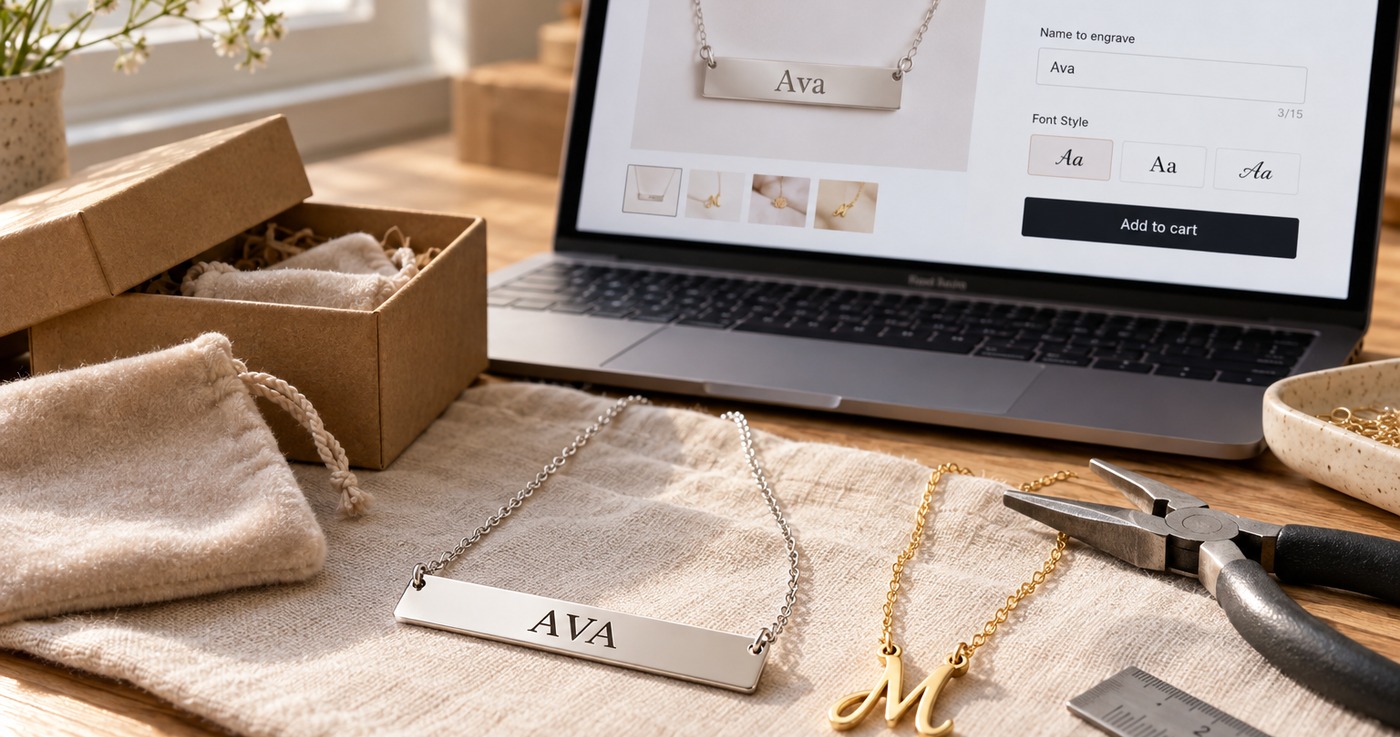
If you engrave, the product page needs a text field with a character limit that fits the piece. A live preview helps more, because customers spot "Emmma" on a pendant faster than in a text box. Our guide on how to add a personalization option on Shopify covers the general setup.
As a worked example with PIMW Product Personalizer: you add a "Name" field to a bar necklace, set a 12-character limit and pick four of the 35+ fonts. Image swatches handle metal color or birthstone choice. The name appears on your product photo as the customer types, and a back engraving can carry its own fee as a separate cart line.
The personalization is saved on the order as line-item properties, so Name, Font and Metal show on the order and packing slip. Photo and logo upload and conditional logic are on Pro. At the time of writing (October 2026), PIMW has a free plan, plus Basic at $7.99 a month, Pro at $13.99 and Unlimited at $24.99, with no per-sale fee, and it works on every Shopify plan. See our comparison of jewelry personalizer apps for alternatives.
Add ring size and chain length guides
Sizing causes more exchanges than anything else in jewelry. Put the guide next to the size picker, not in the footer.
For rings, show the size systems your buyers use (US, UK and Indian sizes differ), a printable sizer and a tip such as "between sizes, size up for wide bands." Our page on engraved rings shows how ring options are usually set up.
For necklaces, show a diagram of where common lengths sit, from choker to below the collarbone, and say whether the length includes the clasp.
Use metafields for material and care
Metafields add structured details to each product: metal, plating thickness, stone, dimensions, weight and care. Your theme can show them as a spec block on every product page.
Keep them factual. "Sterling silver (925), 18K gold vermeil" is a spec. "Luxury quality" isn't. Our post on product options apps vs metafields explains which data belongs where.
Payments, fraud and chargebacks
Jewelry attracts card fraud because it's valuable, small and easy to resell. One fraudulent order for a gold piece can wipe out a month of profit.
Shopify's fraud analysis rates each order low, medium or high risk and recommends whether to fulfill, confirm with the customer first or consider canceling. For jewelry, set house rules:
- Read every medium and high risk order before you engrave. An engraved piece can't be resold.
- Watch for mismatches. Different billing and shipping countries, a failed address check, several declined cards.
- Email the buyer before shipping a high-value piece. Confirming details is normal in jewelry.
- Cancel and refund if unsure. Shopify says it doesn't cover charge reversals from banks.
A chargeback is a cardholder disputing a charge with their bank. Shopify's Help Center explains that the bank takes the amount plus a chargeback fee from you straight away. You can submit evidence, and the card issuer decides. Tracking with a signature, the customer's typed engraving and your published policy make strong evidence.
Shipping jewelry safely

Insure it, get a signature on valuable orders, and pack it so it doesn't rattle.
In the US, at the time of writing, USPS includes $100 of insurance with Priority Mail, Priority Mail Express and Ground Advantage, and sells cover up to $5,000. Registered Mail can be insured for up to $50,000 at a Post Office. Signature Confirmation was $4.15 online.
If you buy labels through Shopify Shipping in the US, insurance administered by Shipsurance covers up to $5,000 per shipment, at $0.89 per $100 domestic and $1.29 per $100 international. Grow and Advanced stores using Shopify Payments get up to $200 included.
Outside the US, read your carrier's terms. Some services exclude jewelry or cap compensation for it.
| Order value | Insurance | Signature | Packaging |
|---|---|---|---|
| Under $50 | Carrier's included cover | Optional | Small box in a padded mailer |
| $50 to $250 | Top up to full value | Recommended | Rigid box in a padded mailer |
| Over $250 | Full value, or Registered Mail | Required | Plain outer box, no brand name outside |
Clip the chain to a card insert so it can't tangle. On expensive orders, keep your brand off the outside. "Gold Jewelry Co." on a label is an advert for thieves. Gift boxes and presentation are covered in the selling guide.
Write a returns policy for both kinds of pieces
You'll probably sell stock pieces and personalized pieces, so treat them differently, and show the policy on every product page. Wording you can adapt:
- Non-personalized: "Return unworn items in original packaging within 30 days for a refund or exchange. Earrings can't be returned unless faulty."
- Personalized: "Because personalized items are made for you, we can't accept change-of-mind returns. If we made a mistake or the item is faulty, we'll remake it or refund you."
- Sizing: "We'll exchange a non-engraved ring for another size once, free."
Check this against the law where your buyers live. Our guide to returns and refunds for personalized products covers wording in more depth.
Build trust before the first sale
A new store has no reviews, and buyers are about to spend real money. Give them reasons to believe you.
- About page. Who you are, where you work, how pieces are made. A photo of your bench beats a paragraph of brand language.
- Care instructions. A care page per metal, linked from every product page, plus a care card in the box.
- Materials disclosure. State the base metal under any plating. If you say gold or silver, the hallmarking rules in our selling guide apply.
- Reviews. Install a reviews app before launch and ask for a photo of the piece being worn. Never post made-up reviews.
Our gold jewelry page shows how stores usually list karat and plating.
Launch checklist and your first 30 days

Run through this before you open.
| Check | Done when |
|---|---|
| Business and tax | You can collect and report tax where required |
| Payments | A real test order went through and was refunded |
| Fraud routine | You know who checks risky orders, and when |
| Shipping | Rates include insurance; signature above your threshold |
| Personalization | Engraving text shows on the order and packing slip |
| Size guides | Ring and chain guides sit next to the picker |
| Policies and trust pages | Returns, shipping, About and care pages are live |
| Mobile | You ordered on your phone from start to finish |
For a longer list, see our personalization launch checklist.
Marketing in the first 30 days
You don't need a big ad budget yet. Show the piece being made and worn.
- Instagram: reels of engraving, a name appearing on metal, a piece worn in daylight.
- Pinterest: vertical gift-idea pins linking straight to products. Our Pinterest strategy guide covers formats.
- TikTok: packing orders, "what I engraved today," before and after polishing.
Add an email signup from day one with a reason to join, such as holiday order deadlines. Our playbook on email marketing for POD applies to jewelry too.
Build one gift-guide landing page for your next occasion, such as "Gifts for new moms," and point all your content at it.
Then set up Google Shopping through the Google & YouTube channel, with titles that include metal and type, correct prices and real photos. Our guide to Google Shopping ads for Shopify walks through the feed.
Metrics to watch
| Metric | Why it matters for jewelry |
|---|---|
| Conversion rate | Shows whether photos, price and trust signals work |
| Cart to checkout rate | Drops often mean shipping costs surprised people |
| Average order value | Tells you if add-ons and sets work |
| Remake rate | Typos and sizing errors eat margin fast |
| High-risk orders and chargebacks | Early warning that fraud rules need tightening |
Check these weekly. In month one, the remake rate usually teaches you the most.
Common mistakes to avoid
We see the same problems in new jewelry stores again and again:
- Too many products at launch. Start with 10 to 20 sampled pieces, not 200 from a catalog.
- Variants for everything. Variants for metal and size, fields for text.
- No character limits. A long name on a small pendant means a remake.
- Vague metal descriptions. "Gold" on a plated piece can break the law.
- No insurance or signature on valuable parcels. One lost parcel costs more than months of cover.
- Engraving before checking fraud risk.
- Skipping the test order. Place one per product type and read what arrives.
When your catalog grows, our pick for the best Shopify jewelry personalizer covers which features matter most. If part of your range is print-on-demand, PIMW connects with Printful, Printify and Gelato, so orders reach the supplier with the customer's text attached.
Start small, sample everything and protect every high-value order.
Frequently asked questions
How do I start a jewelry business online with Shopify?
Pick one business model and a narrow niche, register the business and set up tax, order samples from two or three suppliers, then build a small Shopify store with a jewelry-friendly theme, collections by type and metal, variants for metal and size, and a personalization field if you engrave. Add fraud checks, insured shipping and a clear returns policy before launch.
How much does it cost to start a jewelry business on Shopify?
It depends on your model. Print-on-demand needs little more than samples and a Shopify plan, while handmade and wholesale stores need tools or stock. Shopify plan prices vary by country and billing term, so check the pricing page from your own country. In the US, the SBA says most businesses pay less than $300 to register.
Do I need a business license to sell jewelry online?
Often, yes. In the US you may need state registration, an EIN, a state tax ID and local licenses depending on where you live. In the UK you can trade as a sole trader straight away but must register for Self Assessment if you earn more than £1,000 in a tax year. In India, most online sellers register for GST early.
Which Shopify plan is best for a jewelry store?
Basic is usually enough for a new jewelry store. Move to a bigger plan when its lower card rates save more than the extra monthly cost. Prices vary by country, currency and billing term.
Should engraving be a variant or a line-item property?
Use a line-item property. Variants suit choices that change the stock item, such as metal, ring size and chain length. Engraving text has endless combinations, so it belongs in a personalization field that saves the text on the order.
How many variants can a Shopify jewelry product have?
Shopify allows up to three options and up to 2,048 variants per product. Shopify also notes that some themes, apps and sales channels don't support more than 100 variants, so keep your variant grid small where you can.
How should I ship jewelry from my Shopify store?
Insure every parcel to its full value, require a signature on valuable orders, and pack the piece in a small rigid box inside a padded mailer or plain outer box. In the US, at the time of writing, USPS includes $100 of insurance on Priority Mail and Ground Advantage and sells cover up to $5,000, with Registered Mail insurable up to $50,000.
How do I prevent chargebacks on jewelry orders?
Read every medium and high risk order in Shopify's fraud analysis before you engrave or ship, contact the buyer to confirm high-value orders, and cancel if you're unsure. Keep tracking with signature confirmation and the customer's typed personalization as evidence if a dispute happens.
Keep exploring
Sources & further reading
Primary sources referenced in this article. We link to official platform documentation and standards bodies rather than secondary summaries so you can verify claims directly.
- U.S. Small Business Administration: Register your business
- Shopify Help Center: Adding variants (up to three options and 2,048 variants per product)
- Shopify Dev Docs: line_item object (line item properties)
- Shopify Help Center: Fraud analysis
- Shopify Help Center: Chargebacks and inquiries
- Shopify Help Center: Shipping insurance with Shopify Shipping
- USPS: Insurance and extra services (insurance, Registered Mail, Signature Confirmation)